If you've ever scrolled back through your camera roll looking for that one perfect photo of your pet — the one that really captures them — you're in very good company. From early cave drawings to painted portraits and photography, humans have always sought to preserve the connections we share with animals. In this article, we will trace the history of pet portraits, explore their origins and how they have become a more accessible and personalized art form today.
Earliest History of Pets in Art

The earliest known depictions of animals date back over 45,000 years to cave paintings on the Indonesian island of Sulawesi (as revealed in Sapiens Magazine). While not true pet portraits, they reveal an early desire to capture animals in art. More direct evidence of pets in art appears in ancient Egyptian tomb paintings (c. 2000 BCE), where depictions of dogs, cats, and other animals suggest they held a meaningful place in everyday Egyptian life. In ancient Egypt, pets were considered sacred gifts from the gods and believed to reunite with their owners in the afterlife (World History Encyclopedia). That idea — that animals are family, and that the bond deserves to be honoured — turns out to be anything but new.
Pet Portraits Through the Ages: Renaissance to the 20th Century
The Renaissance: Status and Symbolism
 Most historians trace the first true commissioned pet portraits to the Renaissance, when European royalty and nobility began including their prized animals in grand portrait settings. These weren't just paintings. They were a declaration: this animal matters to me, and I want the world to know it. A notable early example is the "Arnolfini Wedding Portrait" (1434) by Flemish artist Jan van Eyck, which depicted a couple and a small dog at their feet (The National Gallery). Sound familiar? The impulse to show the world how much your pet means to you hasn't changed in 600 years — only the medium has.
The Baroque Period: Emotion and Aristocratic Identity
 In the Baroque period (17th century), portraiture became more dynamic and emotionally expressive. Artists leaned into drama, movement, and feeling — and pets became a regular fixture, their presence reinforcing themes of loyalty and elite identity. Painters like Anthony van Dyck depicted subjects with their animals, notably "The Three Eldest Children of Charles I" (1635) (The Art Story, Anthony van Dyck).
The Georgian & Victorian Eras: Pets as Companions and Subjects
 By the 18th and 19th centuries, attitudes towards pets shifted significantly, with animals increasingly viewed as beloved companions rather than status symbols. Portraits became more intimate, often depicting pets naturally in domestic settings alongside their owners. Artists such as George Stubbs became celebrated for paintings of animals as the main subject, influencing Philip Reinagle, whose best-known work "Portrait of an Extraordinary Musical Dog" (1805) shows a brown spaniel seated at a piano in an almost human-like manner (World History Encyclopedia). It's a painting that makes you smile — because anyone who has watched their own dog act like a small person will immediately understand the joke.
The 20th Century: The Rise of Animal Photography
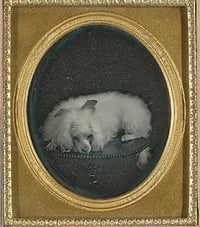 By the 20th century, advances in animal photography and printing technology made fine-art pet portraits more accessible, shifting them from elite commissions to personal keepsakes. Early pioneers like William Henry Fox Talbot and Louis Daguerre used this new technology to document wildlife and domesticated animals. An 1850s photograph, "Poodle With Bow on Table" (photographer unknown), is considered one of the earliest pet portraits — a small, tender milestone in the history of animal photography. Even then, someone cared enough about their dog to make sure they looked their best.
From Keepsakes to Masterpieces: Pet Portraits Today
Historically, pet portraits were reserved for the elite, where the inclusion of pets symbolized wealth and status. Over time this evolved, with pets becoming central subjects of emotional expression. Today, commissioned pet portraits blend tradition with modern techniques — while many continue the fine-art tradition of painting, photography offers new ways to capture pets with precision and artistry, inspired by times of old.
At Haus of Claws, our custom portraits are crafted with the same level of artistry, using tailored set designs and dramatic lighting to reflect your pet’s unique personality. Your pet is already a central part of your story. Browse our pet portraits portfolio and see what it looks like when that story is told beautifully.